
What Happens If You Miss a Court Hearing in India?
Missing a court hearing, also called missing a court date or court appearance, can have different consequences depending on the circumstances.
Missing a court hearing does not automatically mean your case is over. However, the consequences can be real, and acting quickly matters. What happens next depends on the type of case you’re involved in, your role in it, and the court’s response.
Whether you’re a petitioner, respondent, complainant, defendant, or accused person, understanding the possible consequences can help you take the right steps. This guide explains what may happen if you miss a court hearing in India, what you should do next, and how to avoid missing important court dates in the future.
Quick Answer: What Happens If You Miss a Court Hearing in India?
If you're looking for a short answer:
- Missing one hearing does not automatically end your case, but it can lead to serious consequences depending on the situation.
- Petitioners and plaintiffs (those who filed the case) risk their case being dismissed or marked for non-prosecution if they are absent without cause.
- Respondents and defendants (those the case is filed against) may face ex parte proceedings, where the court continues without them and decides based only on the other side's evidence.
- In many criminal cases, accused persons may face more immediate consequences for non-appearance than parties in civil proceedings.
- Acting quickly after a missed hearing is essential. Delay can turn a manageable situation into a much harder one to recover from.
Why Court Hearings Matter
Court hearings are not just formalities. They are the moments when progress is made: evidence is presented, arguments are heard, orders are passed, and dates for the next steps are fixed.
When a party is absent without prior arrangement, it creates uncertainty for the court. In some situations, the court may simply adjourn to another date. In others, it may proceed, or close the matter entirely.
Courts in India expect parties (or their lawyers) to be present at hearings when directed. Repeated absences, even without any bad intention, can signal to the court that the absent party is not serious about the case.
Section 1: What Happens If the Petitioner, Plaintiff, or Complainant Misses a Hearing?
If you are the person who filed the case, whether a petition, a suit, a complaint, or otherwise, your absence can affect your case differently depending on the type of proceedings.
Civil and Family Cases
In civil matters (property disputes, divorce, maintenance, etc.), if the person who filed the case is absent at a hearing, the court may:
- Grant an adjournment on the first or second occasion, particularly if an application was filed or a reason was communicated.
- Dismiss the case for non-prosecution if the court finds that the petitioner/plaintiff is repeatedly absent and not pursuing the matter. This means the case is closed, not because you lost on the merits, but because the court treated the absence as an abandonment of the proceedings.
- Dismiss for default, depending on the stage of the case and the court's rules.
A dismissal for non-prosecution is not necessarily the end, in many situations it may be restored, subject to the court being satisfied that sufficient cause existed.
Criminal Complaints
If you filed a private criminal complaint (for example, under the Bharatiya Nyaya Sanhita or in a cheque bounce matter under Section 138 of the Negotiable Instruments Act) and you do not appear at hearings, the complaint may be dismissed and, in some situations, the accused may be acquitted. Repeated absence by the complainant is often treated as an indication that the complaint is not being actively pursued.
Section 2: What Happens If the Respondent, Defendant, or Accused Misses a Hearing?
The consequences here can be more immediate, especially in criminal matters.
Civil Cases
If you are the person the case is filed against and you miss a hearing, the court may:
- Initially adjourn the matter, particularly at early stages.
- Eventually issue an ex parte order, which means the court proceeds without your participation.
What is an ex parte order? An ex parte order is passed when one party (usually the respondent or defendant) is absent. The case continues, evidence is recorded, and a decision is made based only on what the present party (the petitioner or plaintiff) has shown. You don't get to cross-examine, present your version, or challenge the other side's claims. An ex parte proceeding places the absent party at a significant disadvantage because they lose the opportunity to present their version of events or challenge the other side’s evidence.
If an ex parte order has been passed against you, there may be a process to apply to have it set aside, but you'll need to act promptly and show the court a genuine reason for your absence.
Criminal Cases
If you are an accused person and you miss a hearing when you were required to appear, the court has several options available, depending on the circumstances:
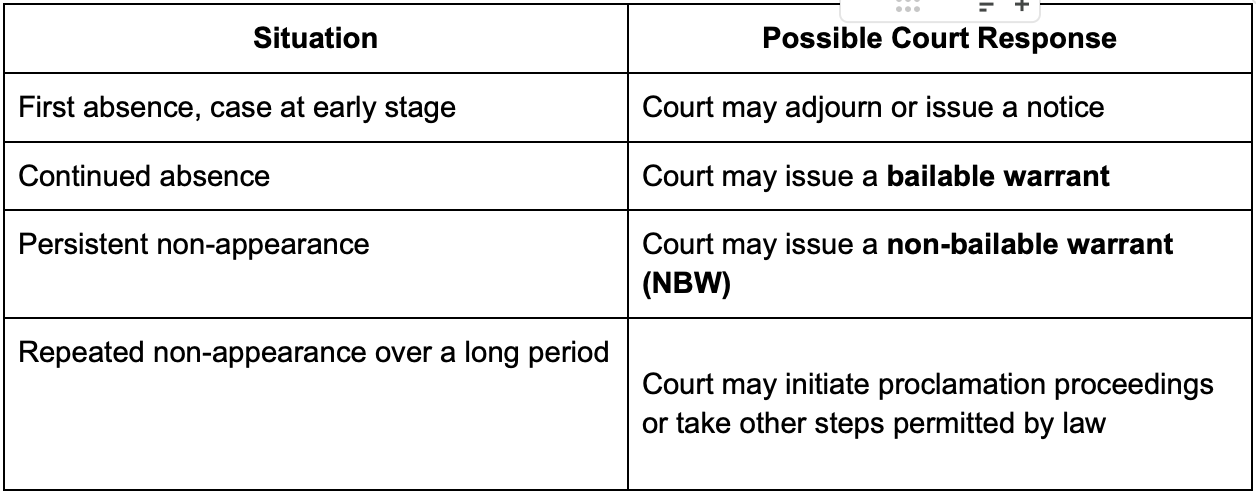
What's the difference between bailable and non-bailable warrants?
- A bailable warrant allows you to be released on bail after being brought before the court. It's a summons to appear, backed by the possibility of arrest.
- A non-bailable warrant (NBW) is more serious. If arrested on an NBW, the right to bail is not automatic, it must be decided by the court. An NBW on record can also create complications for travel, employment, and other matters.
- Being declared a proclaimed offender is a more extreme step, reserved for situations where a person has been consistently evading the court. It carries serious legal consequences and makes surrender or arrest far more complicated.
Courts exercise discretion in these matters, and the stage of the case, prior conduct, and the nature of the offence all play a role. Not every absence leads immediately to a warrant. But the risk is real, and it escalates with time.
Section 3: Why Missing a Hearing Is Usually More Serious in Criminal Cases
In criminal cases, courts often require the presence of the accused at important stages of the proceedings. However, in some cases, courts may exempt personal appearance or permit representation through counsel, depending on the circumstances and the court’s orders.
Criminal courts generally take non-appearance more seriously because:
• The state has an interest in ensuring that accused persons participate in proceedings.
• Evidence, identification, and other processes may require physical presence.
• Courts are cautious about allowing criminal matters to drag on without participation.
Missing a hearing in a criminal matter, especially when the court has specifically directed attendance, should never be treated casually.
Section 4: Valid Reasons for Missing a Court Hearing
Courts understand that life is unpredictable. Some circumstances can be treated as legitimate grounds for absence, provided they are properly communicated and supported by evidence. These may include:
- Medical emergencies or hospitalisation (your own, or sometimes a close family member's)
- Serious accidents
- Natural disasters or severe disruptions affecting travel
- Bereavement in the immediate family
- Genuine transportation failures in extraordinary circumstances
- Other situations accepted by the court in its discretion
Important: Simply having a valid reason is not enough on its own. You will generally need to communicate the reason to the court (usually through your advocate) and submit supporting documents, such as a medical certificate or hospital discharge summary. Courts decide on a case-by-case basis, and what one court accepts, another may not.
Reasons such as forgetting the date or being busy with work are often viewed less favourably unless supported by exceptional circumstances.
Section 5: What Should You Do Immediately After Missing a Hearing?
If you've missed a hearing, here are the practical steps to take right away:
1. Check your case status immediately. Find out what happened at the hearing you missed. Was the matter adjourned? Was an order passed? Was a warrant issued? The sooner you know, the better you can respond. Court Click's case tracking feature lets litigants monitor their case status, order updates, and hearing developments from their phone, without needing to visit the court or wait for someone to call them.
2. Contact your advocate without delay. Your lawyer needs to know as soon as possible so they can assess the situation and advise on next steps. In some cases, time-sensitive actions may be needed.
3. Understand exactly what happened. Ask your advocate to explain what occurred at the hearing, whether there was an adjournment, whether an adverse order was passed, or whether any action was taken by the court.
4. Gather supporting documents. If your absence was for a genuine reason, collect supporting evidence (medical records, hospital bills, any certificates relevant to the reason). These will be needed if an application explaining the absence needs to be filed.
5. Follow your advocate's guidance closely. This is not a situation to manage on your own. Your lawyer will advise whether an application needs to be filed, whether a restoration is possible, or what the next appropriate step is. Acting on proper legal guidance is essential.
Section 6: Common Misconceptions About Missing a Court Hearing
A few things that people sometimes assume but shouldn't:
"Missing one hearing means I've lost the case." Not necessarily. The outcome depends on many factors, the type of case, your role, the court's response, and how quickly you act. One absence, especially at an early stage, does not automatically determine the outcome. But it should not be ignored.
"The court will definitely issue a warrant right away." Courts exercise discretion. A warrant is not always the immediate response to a first absence, especially in civil cases. That said, in criminal matters, particularly at advanced stages, the risk is much higher, and some courts do act quickly.
"I can just turn up at the next hearing and it'll be fine." In some cases, you may be able to do this. But in others, particularly if an ex parte order has been passed or a warrant has been issued, simply showing up at the next hearing without any prior communication or application may not be enough. Your advocate needs to be involved.
"Someone else can attend informally on my behalf." A friend or family member generally cannot represent a party before the court unless legally authorized. Courts require representation by a legally authorised advocate, or in appropriate cases, personal appearance.
Section 7: How Court Click Can Help You Stay Ahead
Many missed hearings happen for the simplest of reasons: people lose track of dates, cases move unexpectedly, or court updates don't reach the litigant in time.
Court Click helps litigants stay informed about their cases through real-time notifications, so they're not caught off guard. The app sends alerts for:
- When a new hearing date is posted
- A reminder before hearing day arrives
- When the case is listed for hearing
- When an order or judgment has been uploaded
- When a case is disposed of or a final judgment is passed and more...
For litigants with more than one case, the Smart Calendar brings all upcoming hearing dates together in a single view, making it easier to plan ahead and avoid missed dates.
When courts upload orders, Court Click allows users to view, translate, and summarise them in simple language, which helps litigants actually understand what happened in their case, without having to wait for someone to explain it to them.
Keeping track of hearing dates and case updates can be genuinely difficult, especially in long-running matters where months pass between hearings. Court Click's case tracking tools help users stay informed about important updates and upcoming proceedings.
Key Takeaways
- Missing a court hearing in India does not automatically end your case, but consequences can be serious and vary by case type and your role in it.
- Petitioners and plaintiffs risk dismissal for non-prosecution; respondents and defendants risk ex parte orders.
- Accused persons in criminal cases face the most immediate risk, including bailable and non-bailable warrants.
- Valid reasons for absence need to be communicated promptly and supported by evidence.
- Acting quickly after a missed hearing — checking case status, contacting your advocate, and taking appropriate steps — is essential.
- Staying informed through reliable case tracking reduces the risk of missed hearings in the first place.
Frequently Asked Questions
What happens if I miss a court hearing in India? The outcome depends on the type of case and your role in it. If you're the petitioner, the case may be dismissed for non-prosecution. If you're the respondent, the court may proceed ex parte (without you). In criminal cases, courts can issue warrants. Acting quickly after a missed hearing is important.
Can a case be dismissed if I miss a hearing? Yes, it can. If you are the petitioner or plaintiff and are repeatedly absent without explanation, the court may dismiss the case for non-prosecution or default. This does not mean the case is permanently over in all situations, restoration is sometimes possible, but it creates significant delay and expense.
What happens if an accused misses a court date? Depending on the stage of the case and the court’s assessment, the court may issue a bailable warrant, a non-bailable warrant, or initiate other proceedings permitted by law in cases of continued non-appearance.
Can a warrant be issued for missing court? Yes. In criminal cases, courts can and do issue warrants when an accused person fails to appear as directed. The severity of the warrant (bailable vs. non-bailable) depends on the circumstances.
What should I do after missing a hearing? Check your case status immediately, contact your advocate without delay, understand what happened at the hearing, collect supporting documents if your absence was for a genuine reason, and follow your lawyer's guidance on next steps.
Can my lawyer attend on my behalf? In many civil matters, your lawyer can appear for routine hearings without you being personally present. However, there are specific stages, particularly in criminal cases, where the court requires your personal appearance. Always confirm this with your advocate.
What is an ex parte order? An ex parte order is one passed by the court in the absence of one party (usually the respondent or defendant). The proceedings continue, evidence is recorded, and a decision is made based only on what the present party has shown. These orders place the absent party at a significant disadvantage because they lose the opportunity to present their version or challenge the other side’s evidence.
Can a dismissed case be restored? In many situations, yes, but subject to conditions. You'll generally need to file an application for restoration, provide sufficient cause for the absence or dismissal, and in some cases pay costs as directed by the court. The process takes time and adds to the overall expense of the case. There is no guarantee of restoration.
Will missing one hearing affect my entire case? Not always, particularly if it was a first absence at an early stage and the matter was adjourned. But in other situations, especially if an ex parte order was passed or a warrant issued, a single absence can have consequences that take considerable time and effort to address.
Is missing a hearing in a criminal case more serious than in a civil case? Generally, yes. Criminal cases have stricter attendance requirements, especially once trial proceedings begin. The possibility of coercive measures (warrants) is more immediate, and the impact on bail conditions is a real risk.
How can I check my next hearing date? You can check your case status on your state's High Court website, the eCourts portal, or the DCMS platform (for district courts). Court Click provides a simpler way, once a case is added to the app, users receive automatic notifications whenever a new hearing date is posted or updated, along with reminders before the date arrives.
What if I missed a hearing due to a medical emergency? A genuine medical emergency is generally understood to be a valid reason for absence, but you will need to support it with documentation (such as a doctor's certificate or hospital records). Inform your advocate immediately, who can file an appropriate application before or after the missed date explaining the circumstances.
Can I attend the next hearing if I missed one? In some cases, yes, particularly in civil matters where the court has simply adjourned without any adverse order. But if an ex parte order was passed or a warrant was issued, it is not enough to simply appear at the next date. You would need to address what happened first, usually through your advocate. Never assume that showing up later will undo what occurred at the missed hearing without taking proper legal steps.
Does the court always know why I was absent? No. Unless your advocate communicates the reason to the court, through an adjournment application or a formal explanation, the court only knows that you were not present. It will not automatically assume a valid reason. This is why contacting your lawyer quickly is so important.
Keeping track of hearing dates and case developments can be difficult, especially in long-running cases. Court Click's case tracking tools help users stay informed about important updates and upcoming proceedings, so you're never caught off guard.
Disclaimer: This article is intended for general informational purposes only and does not constitute legal advice. The legal consequences of missing a court hearing vary significantly depending on the type of case, the court, the stage of proceedings, and individual circumstances. If you have missed a court hearing or are concerned about your case, please consult a qualified advocate as soon as possible. Nothing in this article should be relied upon as a substitute for professional legal guidance.