
How to Reply to a Legal Notice in India (2026 Guide)
Quick Answer: Replying to a legal notice is not legally compulsory in most civil disputes, but a timely, factual reply is usually the smarter move. It puts your version of events on record and can stop a misunderstanding from turning into a lawsuit. The main exception is a cheque bounce notice under Section 138 of the Negotiable Instruments Act, 1881, where you have 15 days from receiving the notice to pay.
A legal notice can feel alarming, especially when it arrives from an advocate you have never heard of. But a legal notice is a warning, not a verdict. No judge has looked at your case, nobody has ruled against you, and you usually have time to decide how to respond. Many notices are resolved the moment the sender sees that you have read them, understood them and replied seriously.
If you want to understand what a legal notice is and when the law requires one before a case can be filed, we have covered that in a separate guide. This article picks up from there and focuses on one thing: what to do once a legal notice lands in your hands, and how to reply to it.
What Is a Legal Notice? (A Quick Recap)
A legal notice is a formal written communication, usually sent through an advocate, that tells you about a dispute and gives you a chance to resolve it before the sender goes to court. It is not a court order. It is a private communication between you and the other party, and how you respond can shape what happens next.
For who sends legal notices, when they are mandatory and how they are served, read our full guide to legal notices in India.
Is the Legal Notice Genuine? Quick Checks
Not every message that calls itself a legal notice is genuine. Before you reply to, or pay anything on the strength of, a notice, check the basics:
- The sender. A genuine notice is usually signed by a named advocate with an address, contact details and enrolment details, or sent by a clearly identified person or company.
- The dispute. Does it relate to something you recognise, such as a loan, a rent arrangement, a purchase or a job?
- The demand. Be cautious if you are told to pay immediately into a personal account or UPI ID, or to click a link to "settle" the matter.
- Independent verification. Contact the advocate's office using details you find yourself, not the ones in the message.
- Who issued it. A legal notice comes from the other party or their advocate, not from a court. If a court has issued something, it will be a summons or a court notice (see the comparison below).
If you are unsure, ask an advocate to look at it before you respond or pay.
Is It Compulsory to Reply to a Legal Notice?
Generally, no. For most civil disputes, including landlord-tenant issues, contract disagreements and ordinary money-recovery notices, there is no law that says you must send a written reply within a set number of days. A reply is a strategic choice, not a legal obligation.
Some situations make a response practically unavoidable:
- Cheque bounce notices. A demand notice under Section 138 of the Negotiable Instruments Act does not technically require a "reply", but it does require you to act. The drawer has 15 days from receiving the notice to make payment. If payment is not made in that window, the payee can file a criminal complaint. That 15-day clock is a genuine deadline, not a suggestion.
- Contract terms. If an agreement you signed says how disputes must be raised or answered, that clause may set its own timeline.
Whether the sender was legally required to send you a notice at all is a separate question. Our guide explains when a legal notice is mandatory and when it is only optional.
What Happens If You Ignore a Legal Notice?
You can, technically. But ignoring a notice is rarely a good strategy.
- Silence does not erase the notice. If the sender files a case, they can show the court that a notice was sent and no reply came. Courts have, in several cases, treated a notice properly sent by registered post as served even when it comes back marked "refused" or "unclaimed". A court may also take unexplained silence on serious, detailed allegations into account, though that is one factor among many, not an automatic loss.
- Ignoring it does not mean you lose, or that you have admitted anything. What happens depends on the facts, the evidence on both sides and how the matter plays out in court. What silence does cost you is the chance to put your version on record early, while it carries the most weight.
- Replying does not mean surrendering. A reply can deny the allegations, clarify a misunderstanding or point out that the claim has no basis. In many disputes, a firm, factual reply is what ends the matter.
How to Reply to a Legal Notice: Step by Step
Step 1: Read the notice carefully, more than once
Do not skim it and set it aside. Legal notices can be dense, but the key details are usually easy to find on a second read.
Step 2: Identify the essentials
Pull out four things:
- Who sent it: the individual, company or their advocate.
- What is alleged: the exact grievance, in the sender's words.
- What relief is sought: money, possession, an apology or a specific action.
- The deadline, if any: and whether it comes from the sender's own choice or from a statute.
Step 3: Collect your documents and evidence
Gather contracts, invoices, payment receipts, emails, WhatsApp messages, photographs and any correspondence. A reply that refers to specific documents carries far more weight than one built on general statements.
Step 4: Understand the applicable law
The notice will usually hint at the law behind the dispute, such as a tenancy law, the Negotiable Instruments Act, a consumer law or a contract clause. Knowing which rules apply helps you understand what you are being asked to answer. Also check whether the claim may be time-barred: Indian law sets limitation periods for different kinds of claims, and a claim brought too late can fail. An advocate can tell you whether the period has run.
Step 5: Consult an advocate where appropriate
You do not need a lawyer for every notice. But for anything involving significant money, property, criminal allegations or employment termination, get professional advice before you put anything in writing. Once you send a reply, its contents can be used as evidence later.
Step 6: Prepare a factual, measured reply
Stick to facts. Avoid emotional language, sarcasm and blanket denials that are not backed by anything. State your position clearly, refer to your evidence, and do not volunteer information that is not relevant to the allegations.
Step 7: Respond within the applicable timeline where possible
If the notice mentions a deadline, try to meet it. If you genuinely need more time to consult an advocate or gather documents, it is often reasonable to send a short acknowledgement first and a fuller reply shortly after, rather than staying silent until the deadline passes.
Step 8: Send it properly and keep proof
Use a mode that creates a record of delivery, such as Registered Post with Acknowledgement Due (RPAD) or Speed Post. Where the notice itself came electronically, a reply by email may also be reasonable, provided there is reliable evidence of delivery. Many people send the reply by RPAD and email together. Whatever you use, keep copies of the reply and proof of sending and delivery. If the dispute reaches court, being able to prove that your reply was sent, and when it was received, can matter as much as what the reply says.
What Should a Reply to a Legal Notice Include?
The exact content depends on the dispute, but most well-drafted replies cover the same ground:
- Reference to the original notice: its date, and the advocate or party who sent it.
- Acknowledgment of receipt: confirming you received and reviewed it.
- A response to each allegation: addressed one by one, not a vague blanket denial.
- Factual clarification: your version of the events, backed by documents where possible.
- Your legal position, where appropriate: especially if you believe the claim has no legal basis.
- Supporting documents: attached, or referred to for later production.
- A closing paragraph: summarising your position and, where relevant, reserving your right to take further action.
What a point-by-point response looks like
Replying to each allegation separately is easier if you set it out like this before you start drafting:
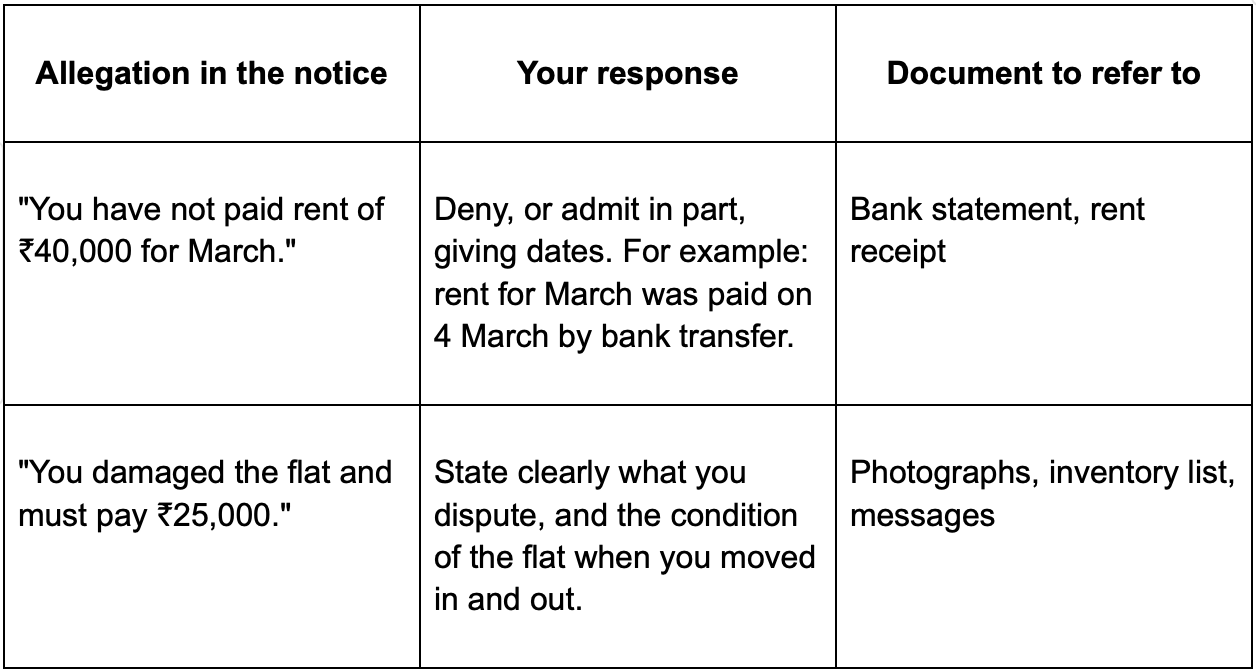
This table is an illustration only. The amounts and facts are invented. Your reply must be based on your own facts and, for anything significant, reviewed by an advocate.
How Many Days Do You Have to Reply to a Legal Notice?
Most notices ask for a reply within 15 to 30 days. It helps to know where that number comes from.
- Some deadlines come from statute, and those are strict. The clearest example is Section 138 of the Negotiable Instruments Act: the drawer of a bounced cheque has 15 days from receiving the demand notice to pay, and missing that window has direct legal consequences.
- Most deadlines are set by the sender, not the law. In most civil disputes, no statute says how many days you get. The 15 to 30 days you see is simply what the sender or their advocate considers reasonable.
- Missing a sender-set deadline does not automatically end your options. It may mean the other side goes ahead with legal action sooner, but a late reply is generally still better than none. Do not treat that as a reason to sit on a notice.
If you need more time, send a short acknowledgment saying you have received the notice and are preparing a detailed reply. It does not extend a statutory deadline, but it shows you are engaging rather than ignoring.
Legal Notice vs Court Summons
People often confuse the two. They are very different.
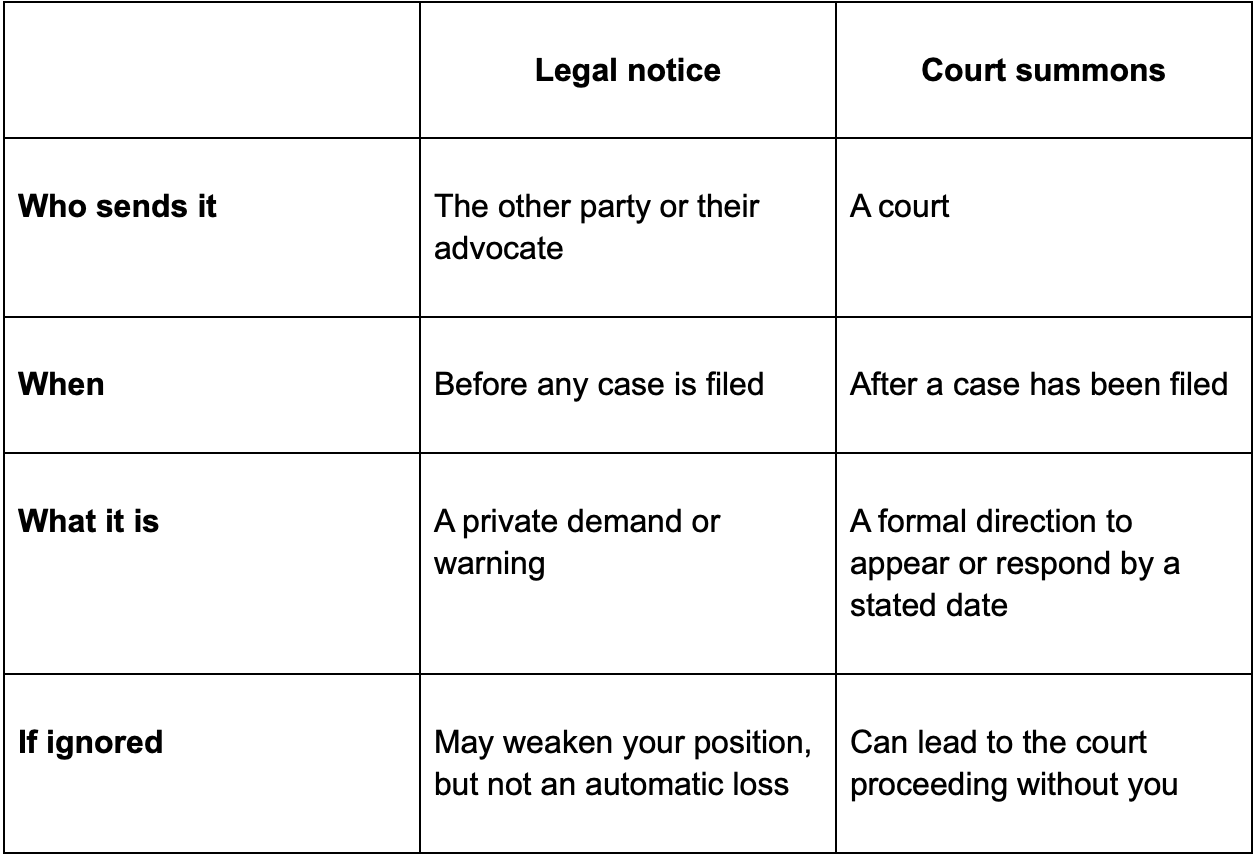
Ignoring a summons is far more serious than ignoring a notice. If a court proceeds in your absence, it can pass an order against you; read what an ex parte order is and what happens if you miss a court hearing in India.
Can You Reply Yourself, or Do You Need a Lawyer?
When replying yourself can be reasonable
For straightforward matters, where the facts are simple, the amount is small, or the notice reads like a routine reminder, a self-drafted reply can be enough to open a conversation. If you are clear on the facts and can state your position plainly, that is often all that is needed.
When to consult an advocate first
Get professional advice before replying if the notice involves:
- A real likelihood that the matter will go to court
- A large financial claim
- Property disputes, especially involving title or possession
- Criminal allegations of any kind
- Employment termination or serious workplace disputes
- Family or matrimonial matters
- Business or commercial disputes
- A statutory notice with fixed legal consequences, such as a cheque bounce notice
This is not about being alarmist. Most legal notices never reach court. But in these situations, the cost of a badly worded reply, such as admitting something by accident or using language that is later read against you, is far higher than the cost of a short consultation.
Common Mistakes When Replying to a Legal Notice
- Ignoring the notice and hoping it will go away
- Replying in anger, with language that reads as aggressive or defensive
- Admitting liability without understanding the consequences, just to "get it over with"
- Sending incomplete information that the other side can exploit later
- Missing a genuine statutory deadline, especially in cheque bounce matters
- Not preserving the documents and messages that support your side
- Not keeping proof that you sent the reply
What Happens After You Reply?
There is no single outcome. Depending on the dispute, a reply can lead to:
- Negotiation between the parties, often through their advocates
- A settlement, formal or informal, that ends the matter without court
- No further action, if your reply satisfies the sender or clears up a misunderstanding
- More correspondence, if either side wants clarification
- Mediation, particularly in commercial disputes where pre-institution mediation may apply
- A court case, if the dispute cannot be resolved. At that point the notice stage is over and the court stage begins: you receive a summons, and what matters from then on is the case status, the hearing dates and any court orders. What happens after you file a civil suit in India walks through each stage.
Key Takeaways
- A legal notice is a pre-litigation communication, not a court order.
- Replying is generally not legally compulsory, except in specific statutory situations such as the 15-day payment window in cheque bounce cases.
- Ignoring a notice does not automatically mean you lose, but it gives up your chance to put your side on record early, and a court may consider unexplained silence as one factor.
- A good reply is factual, specific and backed by documents, not written in anger or under pressure.
- Check that the notice is genuine, and keep proof of how and when you sent your reply.
- For anything involving significant money, property, criminal allegations or employment, speak to an advocate before you reply.
What to Do If the Dispute Reaches Court
A reply often settles the matter. If it does not, and a case is filed, you will need to keep up with what the court is doing, and that is easy to miss when you are relying on phone calls and repeated website checks.
Once you have a case number, you can use the Court Click case tracking app to track your case. After your case is added, you receive notifications when there is a new hearing date, hearing update, court order or judgment, and you can see your case timeline in one place.
*Court Click does not draft legal notices or replies and does not provide legal advice. For questions about your own notice, speak to a qualified advocate.
Frequently Asked Questions
1. Is it compulsory to reply to a legal notice in India?
Generally no. In most civil disputes no law requires a written reply, but replying is usually wise because it records your side. The exception is a statutory notice: for a Section 138 cheque bounce demand notice, the drawer must pay within 15 days of receiving it.
2. What happens if I ignore a legal notice?
You do not automatically lose or admit the allegations. But a court may consider unexplained silence as one factor, and you lose the chance to put your version on record early.
3. How many days do I have to reply to a legal notice?
Most notices ask for 15 to 30 days, but that period is usually the sender's choice, not a legal rule. Statutory notices are different, such as the 15-day payment window in cheque bounce cases. If you need more time, send a brief acknowledgment.
4. Can I reply to a legal notice without a lawyer?
Yes, for simple, low-value matters where the facts are clear. For significant money, property, criminal allegations or employment disputes, consult an advocate first, because your reply can be used as evidence later.
5. Can I reply to a legal notice by email?
Often yes, especially if the notice came electronically. Many people also send the reply by Registered Post (RPAD) or Speed Post so there is firm proof of delivery. Keep copies and proof of sending.
6. What should a reply to a legal notice contain?
A reference to the notice, acknowledgment of receipt, a point-by-point response to each allegation, your facts with supporting documents, your legal position where relevant, and a closing paragraph reserving your rights.
7. Can I admit part of the claim in my reply?
You can if it reflects the facts, but a written admission may be relied on later. Discuss it with an advocate before conceding anything.
8. Does receiving a legal notice mean I will go to court?
No. Many notices are resolved through negotiation, settlement or a satisfactory reply. A notice is an opportunity to resolve things, not a guarantee of litigation.
9. What is the difference between a legal notice and a court summons?
A legal notice comes from the other party or their advocate before any case is filed. A court summons is issued by a court after a case has been filed, and ignoring it can have serious consequences.
10. How do I know if a legal notice is genuine?
Check the sender's name, the advocate's enrolment details and whether the dispute matches something real. Do not click unknown links or pay to unfamiliar accounts. Verify through contact details you find yourself, and ask an advocate if unsure.
11. What if I miss the reply deadline in the notice?
In most civil matters a sender-set deadline is not a legal cut-off, so missing it does not end your options. It may mean the sender goes ahead with legal action sooner, and a late reply is generally better than none. Missing a statutory deadline, such as the 15-day payment window in cheque bounce cases, has direct legal consequences.
12. Can a legal notice be withdrawn?
Yes. A sender can withdraw a legal notice, usually by telling you in writing, for example when the dispute is resolved or the notice was sent in error.
Disclaimer: This article is intended for general informational and educational purposes only and does not constitute legal advice. The appropriate way to respond to a legal notice depends on the applicable law, the type of dispute, contractual obligations and the specific facts of your case. Before replying to a legal notice or taking any legal action, consult a qualified advocate for advice relating to your own matter.